What Does a Digital Marketing Agency Do?
A Complete Guide for Businesses (2026)
A restaurant owner in Uttarakhand once described their marketing setup to us like this:
"One relative handles Instagram, a freelancer runs Google Ads, someone else designed the website, and honestly... I'm not sure if any of them have ever spoken to each other."
That situation is more common than most business owners realise.
Marketing often starts with good intentions, hire someone for social media, bring in another person for ads, and ask a designer to create creatives whenever required. Over time, businesses end up managing multiple people, multiple invoices, multiple timelines, and multiple opinions.
The result? Everything gets done. But very little works together. One advertisement promises premium quality. The website focuses on affordability. Instagram talks casually. Google Business Profile sounds corporate. Customers notice this inconsistency long before businesses do.
This is exactly where a digital marketing agency creates value.
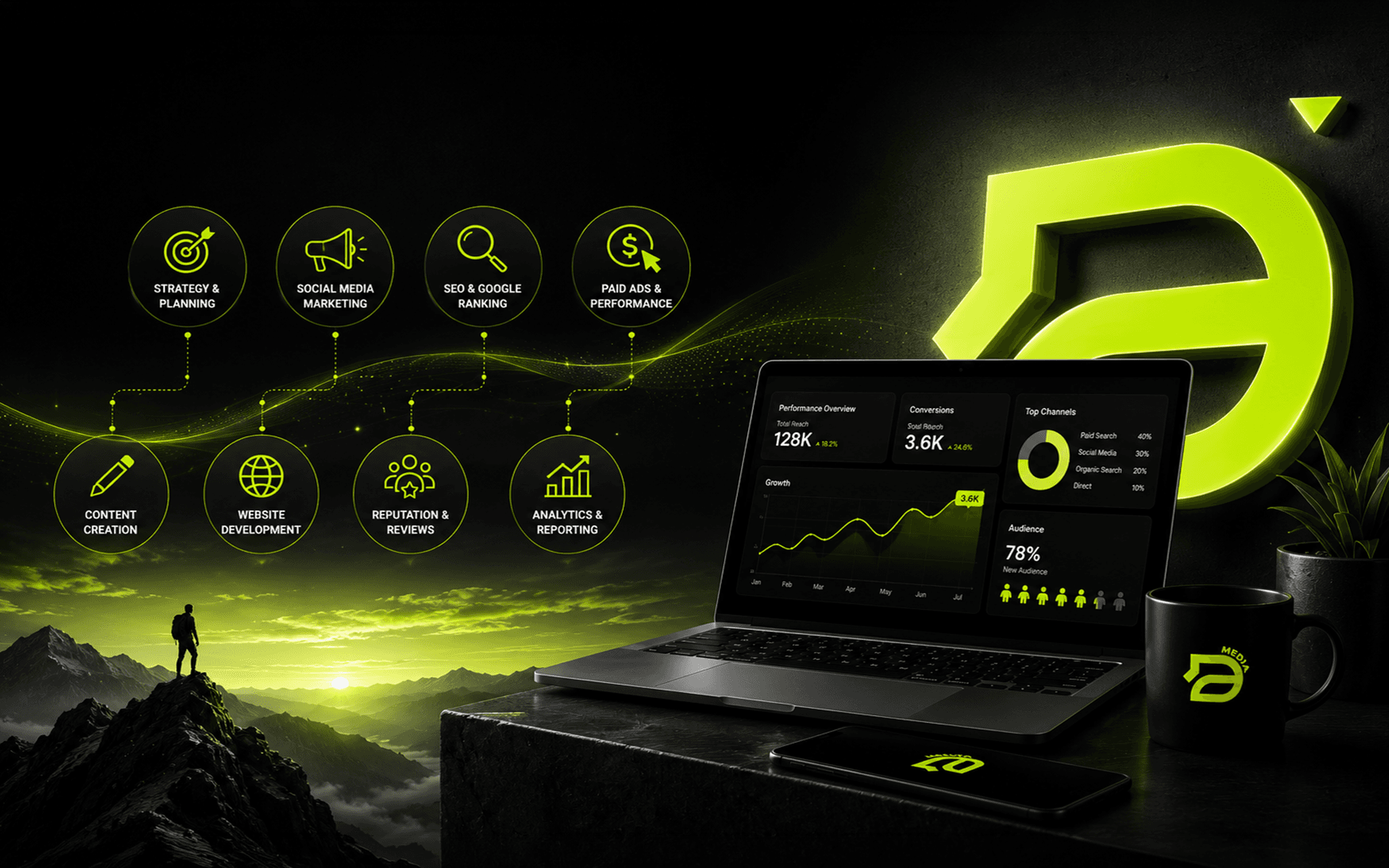
Rather than managing individual marketing activities, a digital marketing agency builds one connected strategy where branding, advertising, content, SEO, design, websites, reputation management, and analytics work together towards the same business objective.
Whether you're a restaurant looking to increase weekday reservations, a real estate developer generating qualified leads, or a retail brand trying to improve online sales, the goal isn't simply to "do marketing."
The goal is to build a marketing ecosystem that consistently attracts, converts, and retains customers.
This guide explains exactly what a digital marketing agency does, how different marketing services work together, and how to decide whether your business actually needs one.
A digital marketing agency helps businesses grow by planning, creating, managing, and optimising marketing activities across multiple digital channels, including:
- Brand Strategy and Positioning
- Social Media Marketing
- Performance Marketing
- Search Engine Optimization (SEO)
- Google Business Profile
- Website Development
- Photography & Videography
- Content Marketing
- Email & WhatsApp Marketing
- Reputation Management
- Analytics & Reporting
Instead of hiring different freelancers or vendors for every activity, businesses work with one coordinated team that manages every marketing touchpoint.
A digital marketing agency helps businesses attract, engage, and convert customers through a combination of branding, websites, SEO, content marketing, paid advertising, social media, analytics, and customer communication. Rather than managing individual marketing activities separately, a full-service agency creates one connected strategy that aligns every customer touchpoint with your business goals.
The Modern Customer Journey
Today's customers rarely make decisions after seeing a single advertisement. Instead, they interact with a brand multiple times before making a purchase. A customer might:
- Discover your business through Instagram.
- Search your business on Google.
- Read customer reviews.
- Visit your website.
- Compare prices.
- Watch your reels.
- Return after seeing a Meta advertisement.
- Finally make a purchase.
Every one of these interactions influences the buying decision. This means every marketing channel must communicate the same story. If your Instagram feels premium but your website looks outdated, trust decreases. If your advertisements promise one thing but customer reviews say another, conversions fall. A digital marketing agency ensures that every customer touchpoint delivers a consistent brand experience.
Why Businesses Need More Than Social Media
One of the biggest misconceptions is that marketing equals social media. Posting regularly on Instagram certainly helps maintain visibility, but social media alone rarely builds a scalable business. Imagine opening a new restaurant. You upload beautiful food photographs every day. People engage with your content.
But when someone searches for: "Best family restaurant near me" your business doesn't appear.
Or they click your website and it takes eight seconds to load. Or they find only three Google reviews while your competitor has over five hundred. Marketing isn't broken. It's incomplete.
Successful marketing combines visibility, trust, and conversion.
That's why a full-service agency works across every customer touchpoint instead of focusing on only one platform.
The Core Functions of a Digital Marketing Agency
Although every agency operates differently, most full-service agencies manage seven core marketing functions. Each one supports the others.
1. Brand Strategy & Positioning
Before creating advertisements or posting on social media, businesses need clarity.
Questions such as:
- Who are we?
- Who is our ideal customer?
- What makes us different?
- Why should customers trust us?
Brand strategy answers these questions before any creative work begins. Without positioning, marketing becomes inconsistent because every campaign communicates something different.
2. Performance Marketing
Paid advertising helps businesses reach potential customers quickly.
This includes:
- Google Ads
- Meta Ads
- Display Campaigns
- Remarketing
- Lead Generation
- Conversion Campaigns
A good agency continuously monitors campaign performance, tests different creatives, improves targeting, and optimises budgets to maximise return on investment.
3. Content Creation
Content is the fuel that powers every marketing channel. This includes:
- Photography
- Videography
- Reels
- Social media creatives
- Blogs
- Website copy
- Email content
Good content doesn't simply look attractive. It educates, entertains, builds trust, and encourages customers to take action.
4. Search Engine Optimisation (SEO)
SEO helps businesses appear when customers actively search for products or services. Rather than paying for every website visitor, SEO builds long-term organic visibility.
SEO generally includes:
- Keyword Research
- Technical SEO
- Local SEO
- Content Optimisation
- On-page SEO
- Google Business Profile Optimisation
Unlike paid advertisements, SEO compounds over time and continues generating traffic even after content is published.
Understanding the individual functions of a digital marketing agency is only half the picture. The next step is understanding how those functions change depending on the business you're trying to grow. Every industry has a different customer journey, buying behaviour, and competitive landscape, which means the marketing strategy should adapt accordingly.
How Marketing Changes Across Different Industries
Not every business markets itself the same way. A restaurant trying to increase weekday reservations has very different marketing goals from a real estate developer looking to generate high-value leads or a healthcare clinic building long-term trust. That's why a good digital marketing agency doesn't follow a one-size-fits-all formula; it adapts its strategy to the industry, customer behaviour, and buying journey.
Restaurants & Cafés
For restaurants, visibility and first impressions are everything. Most customers decide where to eat before they leave home, and that decision is often influenced by Google Maps, Instagram, customer reviews, or a recommendation shared online.
Marketing for restaurants focuses on creating demand while making it easy for customers to discover and choose the business.
Typical activities include:
- Google Business Profile optimisation
- Local SEO
- Food photography and videography
- Instagram Reels and Stories
- Influencer collaborations
- Event and offer promotions
- Reputation management
- Reservation campaigns
A well-timed promotional campaign for a weekday lunch offer, combined with engaging food visuals and positive Google reviews, can significantly improve footfall without relying solely on discounts.
Real Estate
Buying property is rarely an impulse decision. Buyers spend weeks, or even months, researching projects, comparing locations, evaluating developers, and seeking financial advice before making an enquiry.
Marketing in real estate focuses less on immediate sales and more on building credibility while generating qualified leads.
A typical strategy includes:
- Lead generation campaigns
- Landing pages
- Project walkthrough videos
- Drone photography
- WhatsApp automation
- CRM integration
- Email nurturing campaigns
- Google Search Ads
- Remarketing campaigns
Rather than trying to close a sale immediately, the objective is to stay visible throughout the customer's decision-making journey.
Healthcare
Healthcare marketing is built on trust. Patients aren't simply choosing a clinic or hospital, they're choosing professionals they believe can solve an important problem. That makes credibility more valuable than aggressive promotion. Successful healthcare marketing usually includes:
- Educational blog articles
- Local SEO
- Google Business Profile optimisation
- Patient testimonials
- Doctor profiling
- Informative social media content
- Reputation management
- Website optimisation
Providing useful health information consistently helps establish expertise while making it easier for potential patients to find and trust the practice.
Retail & E-commerce
Retail businesses compete for attention every single day. Whether selling fashion, electronics, home décor, or FMCG products, success depends on staying visible while encouraging repeat purchases. Marketing typically focuses on:
- Product photography
- Performance advertising
- Seasonal campaigns
- Influencer collaborations
- Email marketing
- WhatsApp marketing
- Conversion-focused landing pages
- Shopping ads
- Customer retention campaigns
Unlike many industries where a customer may purchase once every few years, retail marketing is designed to increase purchase frequency and customer lifetime value.
Hospitality & Events
Hotels, banquet halls, restaurants, clubs, and event venues thrive on experiences rather than products. Customers want to imagine themselves attending the event before making a booking. Marketing therefore becomes highly visual and emotionally driven. Common activities include:
- Event promotions
- Performance marketing
- Venue photography
- Video walkthroughs
- Influencer marketing
- Google Business Profile management
- Social media storytelling
- Customer review management
- Seasonal campaigns
For businesses in hospitality, consistency across every customer touchpoint, from advertisements and social media to booking confirmations and post-event engagement, plays a significant role in building trust.
Automotive & Car Care
Car owners usually search for automotive services when they have an immediate requirement, making discoverability extremely important. Marketing strategies often focus on:
- Local SEO
- Google Search campaigns
- Before-and-after visuals
- Customer testimonials
- Service reminder campaigns
- WhatsApp updates
- Educational videos
- Google Reviews
Since many customers compare multiple service providers before making a decision, trust, convenience, and positive reviews become key differentiators.
Wedding & Lifestyle Brands
Wedding planning is one of the most emotional purchasing journeys. Couples don't just compare prices, they compare experiences, creativity, attention to detail, and social proof. Marketing in this industry focuses on inspiration as much as information. Typical activities include:
- Portfolio-driven websites
- Cinematic photography and films
- Pinterest and Instagram marketing
- Real wedding stories
- Influencer collaborations
- Client testimonials
- Performance advertising
- Lead nurturing
Visual storytelling becomes one of the strongest conversion tools because customers want to imagine how their own celebration could look.
The Strategy May Change, But the Goal Remains the Same
Every industry requires a different combination of marketing channels, content formats, and customer engagement strategies. What works for a restaurant may not work for a healthcare brand, and what generates leads for a real estate developer may have little impact on a wedding planner.
The role of a digital marketing agency is to understand these differences and create a strategy that reflects the customer's journey rather than relying on a one-size-fits-all approach.
At DRIX Media, we believe every marketing strategy should be built around three questions:
- Who is your customer?
- Where do they make decisions?
- What information do they need before choosing you?
Once those answers are clear, selecting the right channels, content, and campaigns becomes much simpler, and far more effective.
How Different Marketing Services Work Together
One of the biggest misconceptions about marketing is that each activity works independently.
In reality, every marketing channel influences another. Social media may create awareness, but customers often visit your website before making a decision. A Google search might lead them to your Google Business Profile, where reviews build trust. An advertisement may generate the first interaction, but consistent content, remarketing, and follow-up communication are often what convert interest into a customer.
This interconnected approach is what separates strategic marketing from isolated marketing efforts.
For example:
- Brand Strategy defines how the business should be perceived.
- Content Marketing communicates that message consistently across platforms.
- Social Media keeps the brand visible and encourages engagement.
- SEO helps customers discover the business when they're actively searching.
- Performance Marketing accelerates visibility and lead generation.
- Websites & Landing Pages convert visitors into enquiries or customers.
- Email & WhatsApp Marketing nurture prospects and encourage repeat business.
- Reputation Management strengthens trust through reviews and customer feedback.
Each activity supports the next. When one channel improves, the effectiveness of every other channel improves with it.
Marketing isn't a collection of independent services, it's an ecosystem where every touchpoint contributes to the customer's journey.
How Modern Marketing Works Together
Instead of thinking about marketing as individual services, imagine it as one connected ecosystem. The strength of this ecosystem lies in coordination. When one area improves, it creates a positive impact across the entire customer journey.
Why Businesses Are Moving Away from the "One Freelancer Per Task" Model
A few years ago, it was common for a small business to hire one person for Instagram, another for Google ads, and a third for their website. This works ,until the business needs its marketing to feel like one consistent brand voice instead of five disconnected efforts.
A digital marketing agency solves this by putting one team (or one point of contact) in charge of the full picture ,so a Meta ad, a GMB post, and an Instagram caption all sound like they came from the same brand, because they did.

What Makes a Good Digital Marketing Agency
Not every agency operates the same way. When evaluating one, look for:
- Multi-channel capability ,can they run ads and write content and manage SEO, or do they only do one thing well?
- Industry familiarity ,have they worked with businesses like yours (hospitality, retail, real estate, services)?
- Local market knowledge ,do they understand your city's audience, language mix (Hindi/Hinglish/English), and buying behavior?
- Transparent reporting ,can they show you what's working, in plain language, not just jargon-heavy dashboards?
A Full-Service Agency vs. a Specialist Agency
Some agencies specialize in just one thing ,SEO-only firms, or ad-only shops. These can be a good fit if a business already has strong branding and content and just needs one gap filled.
A full-service agency, on the other hand, is built for businesses that want marketing handled end-to-end ,from the first brand conversation to the ad that runs six months later ,without having to manage multiple vendors and make sure they're all aligned.
The DRIX Growth Framework
At DRIX Media, we believe successful marketing isn't about doing everything at once. It's about doing the right things in the right order. Our approach follows a structured growth framework.
Frequently Asked Questions
- What services does a digital marketing agency typically offer? Most full-service agencies offer paid advertising, social media management, SEO, content creation, branding/design, and reputation management, all under one team.
- Is a digital marketing agency worth it for a small business? For small and local businesses especially, an agency can be more cost-effective than hiring an in-house team, since it gives access to specialized skills (ads, design, SEO) without multiple full-time salaries.
- How is a digital marketing agency different from a freelancer? A freelancer usually specializes in one skill (e.g., only social media or only ads). An agency coordinates multiple specialists under one strategy, so all marketing efforts stay consistent.
- What industries do digital marketing agencies typically serve? Most agencies work across hospitality, retail, real estate, automotive, healthcare, and event/wedding services ,though some specialize in specific verticals based on their experience.
Digital marketing isn't about doing everything, it's about doing the right things, in the right order, for the right audience.
Whether it's building a memorable brand, improving search visibility, generating qualified leads, or creating meaningful customer experiences, every marketing activity should contribute to a larger business objective.
The businesses that achieve sustainable growth aren't necessarily the ones spending the most on marketing. They're the ones building a connected strategy where branding, content, websites, SEO, advertising, and customer engagement all work together.
That's exactly what a modern digital marketing agency is designed to do.
Continue Exploring
Marketing is a broad subject, and every business has different goals. If you'd like to explore specific aspects of digital marketing in more detail, these guides are a great place to start:
- Why Modern Businesses Need a 360° Marketing Partner
- Complete Marketing Services Every Business Needs
- How to Choose the Right Marketing Agency
Or, if you're looking for real-world examples, visit our Case Studies to see how integrated marketing strategies help businesses solve practical challenges across different industries.
Ready to Build a Marketing Strategy That Works Together?
Marketing delivers the best results when every channel supports the next. Whether you're building a new brand, improving your online presence, or looking to generate more qualified leads, a structured marketing strategy creates far greater impact than disconnected efforts.
If you're exploring how a full-service marketing approach could support your business, we'd be happy to start with a conversation.
Let's build something meaningful together. → Contact DRIX Media